checkmenot.

TRILHA DE CONHECIMENTO · BETA

Guitar for accompanying songs

Build clear chords, keep time and adapt songs to your voice. Connect the parts of accompaniment through diagrams, transposition cases and a complete study.

5 checklists33 conhecimentosCarregando marcações…

Abra o que quer entender. Marque o que já sabe. Aprofunde quando precisar.

Todas as checklists33 itens visíveis

0 de 6 marcados como entendidos
  • Choose an instrument you can play comfortably

    Este conteúdo faz parte da compra. Consulte o acesso à trilha.

    FundamentalReservado
  • Support the guitar without trapping your hands

    Este conteúdo faz parte da compra. Consulte o acesso à trilha.

    FundamentalReservado
  • Tune E–A–D–G–B–E without confusing note and octave

    Este conteúdo faz parte da compra. Consulte o acesso à trilha.

    FundamentalReservado
  • Read diagrams, chord symbols and frets without reversing strings

    Este conteúdo faz parte da compra. Consulte o acesso à trilha.

    FundamentalReservado
  • Understand why moving one fret changes the note

    Este conteúdo faz parte da compra. Consulte o acesso à trilha.

    ImportanteReservado
  • Diagnose muted notes, fret buzz and unwanted strings

    Este conteúdo faz parte da compra. Consulte o acesso à trilha.

    FundamentalReservado

0 de 9 marcados como entendidos
  • Em: ring six strings with two fretted notesI can form Em and hear every string without muting its neighbors.

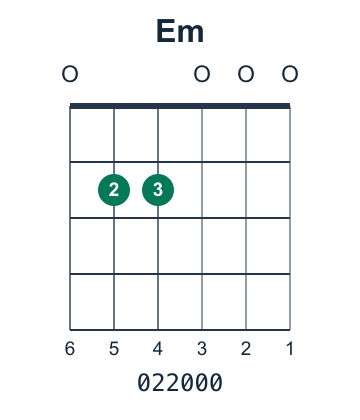
    Em, E minor: 022000. You will form a chord with two fingers and check all six strings separately. Use a guitar in standard tuning: from string six to one, E–A–D–G–B–E. String six is the thickest and string one the thinnest. If the strings are out of tune, fingering alone will not produce the pitches described here.

    In 022000, each number represents a string, from six to one. 0 means an open string; 2 means press at the second fret. Numbers inside the diagram’s dots identify fingers: 1 is the index, 2 the middle and 3 the ring finger. Vertical lines are strings; spaces between horizontal lines are frets. Circles above indicate open strings.

    1. Put finger 2 (middle) on string five, fret two.
    2. Put finger 3 (ring) on string four, fret two.
    3. Leave strings six, three, two and one open. Place your fingertips close to the wire ending fret two, without resting on the metal or pulling a string sideways.
    4. Pluck each string separately from six to one. The pitches are E–B–E–G–B–E: three note names, repeated. Then brush lightly across all six strings.

    Listen especially to the open third string. If it is muted, the finger on string four may be touching it. Arch that finger slightly and check again rather than squeezing harder everywhere. If string five or four buzzes, check contact position before increasing pressure. Use only enough force for the note to ring; do not push through pain.

    Release pressure, rebuild the shape and compare each string with the complete strum. What to check: both fretted strings ring, all four open strings remain clear, and a full strum does not conceal a muted string. This comparison provides a concrete diagnosis; memorizing the shape does not replace listening.

    For a lighter arrangement, the three open treble strings alone also form Em, but change register and weight. That is a voicing choice, not the same six-string sound.

    The diagram below is a copy of the course’s actual original material, showing the same 022000 position. It is available in this preview. The complete chord files listed are optional supports for the paid course; you do not need them to form and check this Em.

    Em diagram: sixth to first strings, fret dots and X for omitted strings.

    Original diagram; numbers in dots identify fingers. See pitches and instructions above.

    Ampliar imagem

    Confira se ficou claro

    Use estas perguntas para conferir seu entendimento. Você decide quando marcar o assunto como entendido.

    Conferência opcional, só enquanto este conteúdo estiver aberto.
    Como este conhecimento ajuda no objetivo

    I can form Em and hear every string without muting its neighbors.

    Materiais complementares

    • ArquivoChords: voicings and changes

      Positions, notes, fingers and transitions.

      Abrir material
    • ArquivoEm chord diagram

      Strings, frets, fingers and omitted notes.

      Abrir material

    Referências

    FundamentalNão marcado
  • Am: begin the bass on string five

    Este conteúdo faz parte da compra. Consulte o acesso à trilha.

    FundamentalReservado
  • E major: hear the difference made by one note

    Este conteúdo faz parte da compra. Consulte o acesso à trilha.

    FundamentalReservado
  • A major: fit three fingers into one fret

    Este conteúdo faz parte da compra. Consulte o acesso à trilha.

    FundamentalReservado
  • C: reach the bass without flattening your fingers

    Este conteúdo faz parte da compra. Consulte o acesso à trilha.

    FundamentalReservado
  • G: connect the bass and first string

    Este conteúdo faz parte da compra. Consulte o acesso à trilha.

    FundamentalReservado
  • D: play four strings and preserve the triangle

    Este conteúdo faz parte da compra. Consulte o acesso à trilha.

    FundamentalReservado
  • Small F: understand a two-string barre and alternatives

    Este conteúdo faz parte da compra. Consulte o acesso à trilha.

    FundamentalReservado
  • Change on time without lifting fingers that can stay

    Este conteúdo faz parte da compra. Consulte o acesso à trilha.

    FundamentalReservado

0 de 6 marcados como entendidos
  • Keep the pulse even when you do not attack

    Este conteúdo faz parte da compra. Consulte o acesso à trilha.

    FundamentalReservado
  • Play a simple strum with controlled volumeI can play four regular attacks while respecting the chord’s strings.

    You will follow a count with four downstrokes on Em, without changing chords. First check standard tuning E–A–D–G–B–E, from the thickest string to the thinnest. Form Em 022000: middle finger on string five/fret two, ring finger on string four/fret two, and the others open. Pluck all six separately to check that none is muted.

    Count 1–2–3–4, 1–2–3–4, using equal intervals. Each sequence is a four-beat bar. Start by counting without playing. A slow pulse that lets you prepare your hand is enough; speed is not the exercise’s goal. With a metronome at 60 BPM, each click represents one beat and each bar lasts four seconds.

    Count12341234
    ChordEmEmEmEmEmEmEmEm
    Attack↓↓↓↓↓↓↓↓

    Move lightly from string six toward string one on each number. ↓ shows the path from bass to treble, not an instruction to hit hard. Let your hand return without sounding between strokes: play on the number and prepare the next movement in the following space. Keep counting even if a stroke sounds weak; rejoin the next beat without compressing intervals to catch up.

    With a pick, use a tip that passes through the strings without catching; avoid burying it between them. Hold it with control but without rigidity. With fingers, try light, comfortable contact. The tones differ, but both work for this exercise; you do not need a collection of accessories.

    Repeat two bars: play the first softly and the second moderately at the same tempo. What to check: eight equally spaced attacks, a silent hand return with no extra attack, and a volume change without a speed change. If the motion catches, reduce force and contact depth before speeding up. Do not push through pain.

    This is a concrete first accompaniment, not a universal musical pattern. When you learn other chords, the stroke’s starting point also changes: you do not automatically play every string in every voicing. For now, stay with the Em described here and listen to your control of the rhythm.

    The complete rhythm material listed is optional and belongs to the paid course. The count, chord and all steps needed for this beginning are included in this preview.
    Confira se ficou claro

    Use estas perguntas para conferir seu entendimento. Você decide quando marcar o assunto como entendido.

    Conferência opcional, só enquanto este conteúdo estiver aberto.
    Como este conhecimento ajuda no objetivo

    I can play four regular attacks while respecting the chord’s strings.

    Precisa de uma base?

    • Em: ring six strings with two fretted notes

      Por que ajuda: Underlying concept and worked example.

    Ferramentas para aplicar este conhecimento

    Keep pulse and compare rhythms

    Choose tempo and grouping to match the example; simplify attacks without moving chord changes.

    Soundbrenner Metronome

    Browser on desktop, tablet or phone.

    Adjust BPM and accents; use tap tempo to estimate a pulse before checking the whole song.

    Acesso: Free browser metronome; no installation or registration is needed to start.

    Limites e fontes

    Define what each click represents before selecting BPM, subdivisions and accents. Clicks provide a timing reference; they do not assess performance quality or technique.

    Informações consultadas em 28/09/2026. Confira as condições atuais no serviço.

    METRONOME ONLINE

    Browser with tempo, meter and subdivision controls.

    Compare meters and subdivisions with the visible controls and hear how grouping changes.

    Acesso: Public metronome controls; ads and separate account features are present.

    Limites e fontes

    Use counting and accents to compare groupings and subdivisions. Service practice tracking and login are not needed to use the metronome.

    Informações consultadas em 27/09/2026. Confira as condições atuais no serviço.

    Materiais complementares

    • ArquivoRhythms with explicit counts

      Grids, rests, fingerpicking and grouping.

      Abrir material

    Referências

    FundamentalNão marcado
    1 base relacionada
  • Place every attack on an eighth-note grid

    Este conteúdo faz parte da compra. Consulte o acesso à trilha.

    FundamentalReservado
  • Distinguish skipping an attack from stopping the sound

    Este conteúdo faz parte da compra. Consulte o acesso à trilha.

    FundamentalReservado
  • Fingerpick bass and treble as different roles

    Este conteúdo faz parte da compra. Consulte o acesso à trilha.

    FundamentalReservado
  • Hear the difference between 3/4, 4/4 and 6/8

    Este conteúdo faz parte da compra. Consulte o acesso à trilha.

    FundamentalReservado

0 de 9 marcados como entendidos
  • Read a chord chart as an incomplete accompaniment map

    Este conteúdo faz parte da compra. Consulte o acesso à trilha.

    ImportanteReservado
  • Know where to enter, repeat and finish

    Este conteúdo faz parte da compra. Consulte o acesso à trilha.

    ImportanteReservado
  • Recognize chord relationships without memorizing every song

    Este conteúdo faz parte da compra. Consulte o acesso à trilha.

    ImportanteReservado
  • Use a capo without confusing shape and sounding chord

    Este conteúdo faz parte da compra. Consulte o acesso à trilha.

    ImportanteReservado
  • Transpose every chord by the same interval

    Este conteúdo faz parte da compra. Consulte o acesso à trilha.

    ImportanteReservado
  • Listen to one layer before copying the strum

    Este conteúdo faz parte da compra. Consulte o acesso à trilha.

    ImportanteReservado
  • Combine voice and guitar by simplifying each layer

    Este conteúdo faz parte da compra. Consulte o acesso à trilha.

    ImportanteReservado
  • Adapt accompaniment without reducing a genre to arrows

    Este conteúdo faz parte da compra. Consulte o acesso à trilha.

    ImportanteReservado
  • Play a complete accompaniment with an entrance and ending

    Este conteúdo faz parte da compra. Consulte o acesso à trilha.

    ImportanteReservado

0 de 3 marcados como entendidos
  • Prepare the instrument, chords and song version

    Este conteúdo faz parte da compra. Consulte o acesso à trilha.

    FundamentalReservado
  • Keep harmony and pulse with an arrangement you can manage

    Este conteúdo faz parte da compra. Consulte o acesso à trilha.

    FundamentalReservado
  • Choose the next adjustment from what you hear

    Este conteúdo faz parte da compra. Consulte o acesso à trilha.

    FundamentalReservado